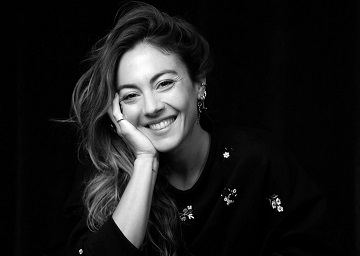
Welcome to Constance Labbé Fan, the latest online resource dedicated to the talented actress Constance Labbé. Constance has been in films like "Coup de Foudre en Andalousie", "Je te veux moi non plus", "Joyeuse retraite! 2" and "Le voyage en pyjama". She has also been in TV Shows like "Groom", "Balthazar", "Piste noire" and "Cat's Eyes". This site is online to show our support to the actress Constance Labbé, as well as giving her fans a chance to get the latest news and images.

Télé 7 Jours interview
Veronique


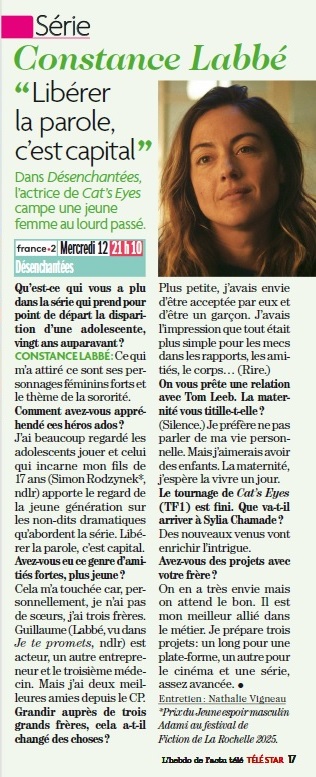
Désenchantées (France 2) – Constance Labbé: “Watching the series can help parents”

INTERVIEW. Constance Labbé plays Angélique, a woman whose best friend disappeared twenty years earlier. She is drawn back into her past when her sister (played by Marie Denarnaud), a journalist, writes about the case.

In your first scene, you break up a fight in a bar-restaurant. That sets the tone!

Constance Labbé: Exactly! (Laughs) When David Hourrègue, the director, first described Angélique to me, he used the word “powerful”. I think it was very important for him to show right away that she’s a woman who doesn’t take any nonsense anymore.

As a teenager, Angélique had an inner anger that sometimes made her want to destroy everything. Did you feel the same fierceness when you were younger?

I wasn’t like her because I played a lot of sports, which helped me let off steam. I also grew up with three older brothers, which helps channel my energy a bit! (Laughs) But I think all teenagers are, at some point, a little rebellious because they’re trying to find their place and have trouble finding it. We sometimes forget what adolescence is like, the intensity of the feelings involved, the difficulty of relating to others and to one’s own body. Watching Désenchantées can help parents.

What would you like to relive from that time?

The absence of cell phones and social media. It was great to really connect with people, to invent games, to call friends by throwing pebbles at the window, to call a landline and say, “Hello sir, could I speak to Victoire, please?” (Laughs)

Are you still in touch with your childhood friends?

I have my group of “désenchantées” friends, including Sophie and Victoire, whom I met in first grade, and who are like sisters to me. We call ourselves the Triplets! The hardest part of our friendship has been seeing each other in our adult lives. When others grow up, move, get married, become mothers, have demanding jobs, or no longer react the same way, it can be disorienting.

Angélique instilled in her son, Eder (played by Simon Rodzynek, winner of the Adami Young Male Hope Award at the 2025 La Rochelle Fiction Festival), that “lying is for cowards”. Is that also your motto?

I don’t lie. It actually annoys me when I hear people say that as an actress, I must be a very good liar… But, for me, acting is completely different. Lying involves emotional and affective manipulation. And that’s something I’m completely incapable of.

It seems you ask your loved ones for their opinion before accepting a project…

Sometimes I talk to my brother Guillaume, because he’s in the same profession and he understands. But less and less, because I’m learning to trust myself more. There are no rules for forging your own path, and it’s not another actor, a mother, or a father who can know which direction to take today.

You have over ten years of experience in the industry. What can we wish you for the next ten years?

Simply to keep working, because this profession is fragile, but also to continue collaborating with different people. I think it’s fantastic to be in a very mainstream entertainment show like Cat’s Eyes, for which I just finished filming the second season, and in a more intimate series like Désenchantées.

Original French article at programme-television.org

  Articles & Interviews - Désenchantées


Paris Match interview
Veronique


Constance Labbé: “Adults tend to downplay what teenagers are feeling”

Constance Labbé stars in the highly successful series “Désenchantées”, currently airing on France 2. We met her at the La Rochelle Fiction Festival, where the series was in competition.

Paris Match: How did you get involved in the series?

Constance Labbé: I was incredibly lucky to receive an offer from director David Hourrègue, with whom I had never worked before. I knew him because he had recently worked with my brother, Guillaume Labbé, on the series “Anaon”. He was familiar with my work, and I was familiar with his. He wrote me an absolutely beautiful letter, telling me he would love to collaborate with me on this role. It was incredibly touching. I’m always surprised when people tell me, “I love your work”, or “I want to work with you”. I hope to be surprised all my life, actually.

Have you read the novel “Désenchantées” by Marie Vareille, which inspired the series?

I wasn’t familiar with the book; I read it afterward and I loved it. I read the adaptation, which was still a work in progress. I really enjoyed that too. I was worried about certain things, which David executed wonderfully. I was very scared; it’s hard to direct teenagers. In fact, I think that’s almost the best part. This dual timeline (between adults and their teenage selves, Ed.)—the way the director explained to me how he wanted to approach it—really appealed to me. He told me I had to trust him, that he wasn’t necessarily looking for people who were similar to him, that he had faith in the power of fiction, the power of editing.

What did you bring of yourself to this character?

I was able to suggest certain things, even during the writing process, about the character, about her journey, which was great. It was really wonderful to be listened to like that. I really worked on it with David, right from the writing stage. In the book, my character, Angélique, is a bit more absent; she’s more central to the series.

What remains with you from this series? Are there things that still resonate today?

Often with my roles, it’s feelings that stay with me, more than character traits or images. Now, talking about it in interviews, things come back, feelings, incredibly strong emotions. Angélique is someone very strong, who has taken a huge blow, who has built up an enormous shell around herself, but who is always walking a tightrope. I also wanted people to feel that it’s not far off. In her gaze, in her eyes, there’s this cracking feeling. He mustn’t be too far away. And I feel that’s where it is.

Did it make you relive your adolescence, for example?

No, not really. I didn’t have the same adolescence at all. Besides, I don’t have a sister, I only have brothers. I was lucky enough to have done the series “Cat’s Eyes” not long ago, where I have two sisters. So, I had already really worked on that relationship.

Do you have any memories of adolescence that came back to you?

That intensity of what you feel when you’re a teenager… Everything is absolute. All the sensations, all the feelings are pushed to the extreme. I remember the letters we wrote to each other when we argued… How dramatic it was. Life stops… And love stories! When the guy you’re in love with doesn’t want to see you. I remember being in love, for example, with the same boy as my friend. But it was so dramatic if she went out with him and I didn’t, or vice versa. I think we adults tend to really downplay what teenagers feel. We’ve forgotten the intensity of those feelings.

How far would you be willing to go for friendship?

Friendship is love. It comes from exactly the same place. Honestly, for the few people who are truly closest to me, I’d be willing to do anything, even swim across the ocean.

There’s a throwback to the 1990s in the series, which is your generation… The Walkman, the Nintendo, the absence of cell phones and social media… We didn’t use WhatsApp to visit each other’s houses… It’s really a Proustian madeleine. There’s definitely a hugely positive side and a hugely negative one. On the one hand, I thought, “Damn, it was so much better without cell phones.” I created games. We went out, we invented all sorts of things because we weren’t on our phones. We made real dates. And at the same time, it was a time when women weren’t really defended, teenagers weren’t listened to, weren’t believed, and freedom of speech wasn’t at all encouraged. There are good things to keep, and there are bad things.

Original French article at parismatch.com

  Articles & Interviews - Désenchantées


Serieously interview
Veronique


Désenchantées : comment se termine la série ? Constance Labbé (Angélique adulte) nous explique la fin

D’ores et déjà disponible en intégralité sur la plateforme France Télévisions, la série Désenchantées diffuse ce mercredi 19 novembre en prime time sur France 2, ses deux derniers épisodes. Comment se termine le programme adapté du livre de Marie Vareille ? Serieously s’est entretenu avec l’actrice Constance Labbé pour qu’elle nous explique la fin, qui ne laissera certainement pas les spectateurs indifférents.

À l’image du roman de Marie Vareille, la série Désenchantées raconte l’histoire de la disparition Sarah Leroy à l’âge de 15 ans. Une disparition qui a non seulement bouleversé ses proches, mais le pays tout entier. Des années après, Fanny, revient à Bouville-sur-Mer pour enquêter sur cette affaire et parler avec le présumé coupable, qui a toujours clamé son innocence. En parallèle, les Désenchantées, un groupe de 3 amis, se retrouvent pour ressasser le passé et enfin mettre la lumière sur les non-dits qui les rongent de l’intérieur.

Au casting, on retrouve Marie Denarnaud, Marc Ruchmann, Jonas Bloquet, Capucine Malarre, Nelligan, Adam Abdo et Constance Labbé, avec qui Serieously a pu échanger.

À travers des flashbacks, on découvre que l’amitié entre Angélique Courtin et Sarah Leroy a été marquée par la célébration des 18 ans d’Erik Chevalier. À cette soirée, on apprend que l‘adolescent a violé Angélique, mais que Sarah a du mal à croire sa meilleure amie en raison des mises en garde de sa belle-mère, qui lui certifie que la jeune fille est une mauvaise fréquentation qui ne parle que pour entacher l’image immaculée de son fils et leur famille.

Suite à cette déclaration, Angélique se rapproche de Jasmine et Morgane qui forment maintenant le groupe des Désenchantées. Peu à peu, l’image caricaturale de fils parfait se retrouve souillée quand Erik est accusé par plusieurs autres adolescentes de viol, dont Sarah Leroy, qui partage cette information à Angélique dans une scène riche en émotion.

Sarah Leroy est-elle vraiment morte dans Désenchantées?

Quand Sarah avoue ce qu’il s’est passé, les Désenchantées, dont elle fait désormais partie, acceptent de l’aider pour mettre en scène sa mort afin qu’Erik ne puisse plus l’atteindre et lui faire du mal. Une nuit, les amies prennent alors la voiture du lycéen et conduisent jusqu’à la mer pour brouiller les pistes et que le véhicule soit vu par les caméras de surveillance. Grâce au vêtement ensanglanté laissé dans la voiture d’Erik, le jeune homme est arrêté quelque jours après par les enquêteurs.

Au fil des minutes des derniers épisodes, Angélique adulte (Constance Labbé) intime à sa soeur Fanny, la journaliste, que Sarah n’est pas morte et est aujourd’hui en Angleterre. Dans un retour en arrière de 25 ans, on découvre que Sarah, avec l’aide des Désenchantées, s’est entraînée pendant plusieurs semaines sans relâche dans le but de traverser la Manche à la nage. Pour se détacher des chaînes et paroles d’Erik, Sarah a choisit de nager vers de nouveaux horizons et un avenir incertain.

Quant à Erik adulte, celui-ci est retrouvé mort sur la plage et ce n’est qu’après que sa mère, Iris, avoue son crime : elle l’a poussé du bord de la falaise par mégarde parce qu’elle voulait simplement le faire taire après avoir appris la vérité sur ses agissements.

Que signifient les dernières scènes de Désenchantées ?

Le quatrième et ultime épisode de Désenchantées se termine sur deux séquences percutantes : dans la première, Angélique adulte retrouve, après deux décennies, Sarah, désormais maman d’une petite fille appelée elle aussi Angélique et vivant au Royaume-Uni. La deuxième, qui vient clôturer la série, montre la traversée de Sarah Leroy, qui a duré 13h28.

Mais que se passe-t-il vraiment après ces retrouvailles ? Serieously a justement demandé à Constance Labbé, figure centrale de ce bouquet final bouleversant, de partager son point de vue : « [J’imagine ces retrouvailles] très très fortes. Presque comme des amoureux qui se retrouvent. Après, je pense qu’il doit y avoir de la gêne, je pense qu’il va y avoir du temps qui va passer donc c’est toujours un peu difficile de retrouver les marques. Mais très très fortes« .

Une saison 2 pourrait-elle voir le jour afin que cette rencontre soit explorée davantage ? « Je pense que la boucle est bouclée puisque le roman est bouclé, et que c’est l’adaptation d’un roman. Il faudrait demander à Marie Vareille d’écrire la suite« , a déclaré Constance Labbé.

Source: serieously.com

English translation:

Désenchantées: How does the series end? Constance Labbé (adult Angélique) explains the ending

Already available in its entirety on the France Télévisions platform, the series Désenchantées airs its final two episodes this Wednesday, November 19th, in prime time on France 2. How does the program, adapted from Marie Vareille’s book, end? Serieously spoke with actress Constance Labbé to find out the ending, which will certainly not leave viewers indifferent.

Like Marie Vareille’s novel, the series Désenchantées tells the story of the disappearance of Sarah Leroy at the age of 15. A disappearance that not only devastated her loved ones but the entire country. Years later, Fanny returns to Bouville-sur-Mer to investigate the case and speak with the presumed culprit, who has always proclaimed his innocence. Meanwhile, les Désenchantées, a group of three friends, reunite to revisit the past and finally shed light on the unspoken secrets that have been eating them up inside.

The cast includes Marie Denarnaud, Marc Ruchmann, Jonas Bloquet, Capucine Malarre, Nelligan, Adam Abdo, and Constance Labbé, with whom Serieously had the opportunity to speak.

Through flashbacks, we discover that the friendship between Angélique Courtin and Sarah Leroy was forged during Erik Chevalier’s 18th birthday party. At this party, we learn that the teenager raped Angélique, but Sarah struggles to believe her best friend because of warnings from her stepmother, who insists that the young woman is a bad influence who only speaks out to tarnish the pristine image of her son and their family.

Following this revelation, Angélique grows closer to Jasmine and Morgane, who now form the group known as les Désenchantées. Little by little, the caricatured image of the perfect son is tarnished when Erik is accused of rape by several other teenage girls, including Sarah Leroy, who shares this information with Angélique in a highly emotional scene.

Is Sarah Leroy really dead in Disenchanted?

When Sarah confesses what happened, the Désenchantées girls, of which she is now a member, agree to help her stage her death so that Erik can no longer reach her and hurt her. One night, the friends take the high school student’s car and drive to the sea to throw investigators off the scent and ensure the vehicle is captured by security cameras. Thanks to the bloodstained garment left in Erik’s car, the young man is arrested a few days later by investigators.

As the final episodes unfold, the adult Angélique (Constance Labbé) tells her sister Fanny, the journalist, that Sarah is not dead and is now in England. In a flashback to 25 years ago, we discover that Sarah, with the help of the Disenchanted, trained relentlessly for several weeks with the goal of swimming across the English Channel. To break free from Erik’s chains and words, Sarah chose to swim towards new horizons and an uncertain future.

As for the adult Erik, he is found dead on the beach, and it is only afterward that his mother, Iris, confesses her crime: she accidentally pushed him off the cliff edge because she simply wanted to silence him after learning the truth about his actions.

What do the final scenes of Désenchantées mean?

The fourth and final episode of Désenchantées ends with two powerful sequences: in the first, the adult Angelique reunites, after two decades, with Sarah, now a mother of a little girl also named Angelique, living in the United Kingdom. The second episode, which concludes the series, depicts Sarah Leroy’s 13-hour and 28-minute swim.

But what really happens after this reunion? Serieously asked Constance Labbé, a central figure in this moving finale, to share her perspective: “[I imagine this reunion] as very, very powerful. Almost like lovers finding each other again. Afterwards, I think there must be some awkwardness, I think some time will pass, so it’s always a bit difficult to find your bearings again. But very, very powerful.”

Could a second season be produced to explore this encounter further? “I think the circle is complete since the novel is finished, and it’s an adaptation of a novel. We should ask Marie Vareille to write the sequel,” said Constance Labbé.

  Articles & Interviews - Désenchantées


Nice matin article
Veronique


«On est aussi là pour faire passer des messages» : avec «Désenchantées» sur France 2, Constance Labbé met la sororité en avant
Figure de « Cat’s Eyes », Constance Labbé donne la réplique à Marie Denarnaud dans « Désenchantées » de David Hourrègue sur France 2. Une série sur les femmes autour de la puissance de l’amitié et de la sororité.

Il y a des projets qui, sur le papier, attirent l’œil d’emblée. L’adaptation du roman Désenchantées de Marie Vareille sur France 2 par David Hourrègue (Germinal, Anaon) avec Marie Denarnaud (HPI, Les papillons noirs) et Constance Labbé (Cat’s Eyes, Piste Noire) rentre parfaitement dans cette catégorie.

Racontée en quatre épisodes, l’intrigue nous amène à Bouville-sur-Mer où la disparition de Sarah, 15 ans, a ému la France entière même si un coupable a vite été arrêté. Car, dans le village, tout le monde est persuadé d’être passé à côté de la vérité.

Vingt ans plus tard, Fanny (Marie Denarnaud), journaliste, revient sur les lieux de ce drame qui a marqué sa jeunesse. Et c’est tout un passé qui resurgit… Car l’histoire de Sarah Leroy, c’est aussi un peu la sienne, celle de sa sœur Angélique (Constance Labbé) et celle d’une bande de filles — « les Désenchantées » — qui ne connaissait que trop bien Sarah.

La trame de la série repose sur le fait que les deux sœurs ne se connaissent pas vraiment.

Sœurs de fiction

« Avec Marie Denarnaud, on se connaissait mais pas vraiment intimement, il y avait une forme de familiarité, une reconnaissance, mais pas tant de vécu ensemble, un peu comme les deux sœurs et cela a facilité la construction de notre duo », analyse Constance Labbé.

Petite sœur de trois grands frères (dont le comédien Guillaume Labbé), l’actrice commence à avoir l’habitude de l’esprit de sororité, elle qui vient de terminer le tournage de la deuxième saison de la série Cat’s Eyes pour TF1. « C’est un lien très différent d’une fratrie, la sororité. J’ai deux amies d’enfance et c’est ce que j’ai de plus proche d’une sororité mais j’ai l’impression qu’entre sœurs, il y a une comparaison évidente car on est du même genre. Il y a parfois un rapport de tension, de jalousie, de comparaison. Dans Cat’s Eyes, il y a une compétition entre les deux grandes sœurs pour obtenir l’amour de la petite dernière. J’ai adoré jouer avec mes sœurs de fiction, cela me permet de chercher autre chose de moi. »

La série de David Hourrègue est une série de femmes qui questionne la puissance de la sororité, de l’amitié, du rôle de mère, du passage à l’âge adulte et le poids du secret. Des thématiques séduisantes à jouer pour la jeune actrice.

Problématiques actuelles

« J’ai adoré m’intéresser à l’amour qui existe entre des femmes, à la puissance du lien amical qui, parfois, peut reproduire le lien familial. On peut mourir pour une amie, poursuit-elle. On fait appel aux liens maternels car on a réellement besoin de se protéger entre femmes et il faut que le monde évolue dans une absence de compétition, en étant solidaire ».

La série aborde des sujets actuels et délicats comme le poids du silence en cas d’agression sexuelle ou viol, la difficulté de prendre la parole et d’être entendue en tant que femmes.

« Je ne connais pas de femmes qui n’ont jamais été confrontées à la peur de la puissance masculine au moins une fois dans leur vie. Il y a une différence physique, de puissance évidente. J’ai eu cette discussion tardive avec mes frères, étaye Constance Labbé. Ils ne peuvent pas imaginer qu’il m’est arrivé plusieurs fois d’avoir peur dans la rue car je marchais seule. Et c’est libérateur de pouvoir porter cette parole en fiction en tant qu’actrice. On est aussi là pour faire passer des messages, rassurer, inciter à parler ».

Bientôt pilote de chasse

C’est un peu le fil rouge de son personnage d’Angélique qu’elle définit comme une « femme intègre, qui peut aller jusqu’au sacrifice pour protéger. Je me suis inspirée de femmes de mon entourage pour la camper. Cette série m’a permis de me rendre compte de la qualité de mon cercle amical. Je trouve ça judicieux de la part des scénaristes d’avoir fait d’Angélique une mère dans la série, ce qui n’était pas le cas dans le livre. Quand on est une femme victime d’abus sexuels, c’est particulier d’élever un garçon sans tomber dans la diabolisation des hommes ».

Après un tel projet, la jeune femme a envie de jouer dans une grosse comédie même si ses projets sont déjà denses puisqu’elle va camper une pilote de chasse dans une série pour Prime Video et M6 dans un univers à la Top Gun. « Un fantasme d’enfance », conclut-elle, tout en précisant être, aussi, dans une période d’écriture intense avec trois scénarios en cours dont deux comédies.

Source: nicematin.com

English translation:

“We’re also here to send messages”: With “Désenchantées” on France 2, Constance Labbé puts sisterhood in the spotlight
A familiar face from “Cat’s Eyes”, Constance Labbé stars alongside Marie Denarnaud in David Hourrègue’s “Désenchantées” on France 2. A series about women exploring the power of friendship and sisterhood.

Some projects, on paper, immediately catch the eye. The adaptation of Marie Vareille’s novel “Désenchantées” on France 2 by David Hourrègue (Germinal, Anaon) starring Marie Denarnaud (HPI, Les papillons noirs) and Constance Labbé (Cat’s Eyes, Piste Noire) perfectly falls into this category.

Told in four episodes, the plot takes us to Bouville-sur-Mer, where the disappearance of 15-year-old Sarah shocked the entire nation, even though a culprit was quickly arrested. Because in the village, everyone is convinced they missed the truth.

Twenty years later, Fanny (Marie Denarnaud), a journalist, returns to the scene of this tragedy that marked her youth. And a whole past resurfaces… Because Sarah Leroy’s story is also, in a way, her own, that of her sister Angélique (Constance Labbé), and that of a group of girls—”Les Désenchantées”—who knew Sarah all too well.

The series’ premise hinges on the fact that the two sisters don’t really know each other.

Fictional Sisters

“Marie Denarnaud and I knew each other, but not really intimately. There was a kind of familiarity, a recognition, but not so much shared experience, a bit like the two sisters, and that made building our dynamic easier,” explains Constance Labbé.

Younger sister to three older brothers (including actor Guillaume Labbé), the actress is getting used to the spirit of sisterhood, having just finished filming the second season of the series Cat’s Eyes for TF1. “It’s a very different kind of bond than sibling relationships. I have two childhood friends, and that’s the closest thing I have to a sisterhood, but I feel like there’s an obvious comparison between sisters because we’re similar. There’s sometimes tension, jealousy, and comparison. In Cat’s Eyes, there’s a competition between the two older sisters to win the youngest’s affection. I loved working with my on-screen sisters; it allows me to explore a different side of myself.” “

David Hourrègue’s series is a women’s series that explores the power of sisterhood, friendship, motherhood, the transition to adulthood, and the burden of secrets. These are compelling themes for the young actress to tackle.

Current Issues

“I loved exploring the love that exists between women, the power of friendship, which can sometimes mirror family ties. You can die for a friend,” she continues. “We draw on maternal bonds because we truly need to protect each other as women, and the world needs to evolve toward a world free from competition, one of solidarity.”

The series addresses current and sensitive topics such as the burden of silence in cases of sexual assault or rape, and the difficulty of speaking out and being heard as women.

“I don’t know any women who haven’t faced the fear of male power at least once in their lives. There’s a physical difference, an obvious difference in power.” “I had this conversation with my brothers later on,” Constance Labbé explains. “They can’t imagine that I’ve often been afraid in the street because I was walking alone. And it’s liberating to be able to express this through fiction as an actress. We’re also here to convey messages, to reassure, to encourage people to speak out.”

Soon to be a fighter pilot

This is somewhat the central theme of her character, Angélique, whom she describes as “a woman of integrity, who can even sacrifice herself to protect others. I drew inspiration from women in my life to portray her. This series has allowed me to realize the quality of my circle of friends. I think it was wise of the writers to make Angélique a mother in the series, which wasn’t the case in the book. When you’re a woman who has been a victim of sexual abuse, it’s a unique challenge to raise a boy without demonizing men.”

After such a project, the young woman is eager to star in a big comedy, even though her projects are already packed, as she will be playing a fighter pilot in a series for Prime Video and M6 in a Top Gun-esque setting. “A childhood dream,” she concludes, while also mentioning that she is currently in a period of intense writing with three screenplays in progress, two of which are comedies.

  Articles & Interviews - Désenchantées - Gallery - Stills


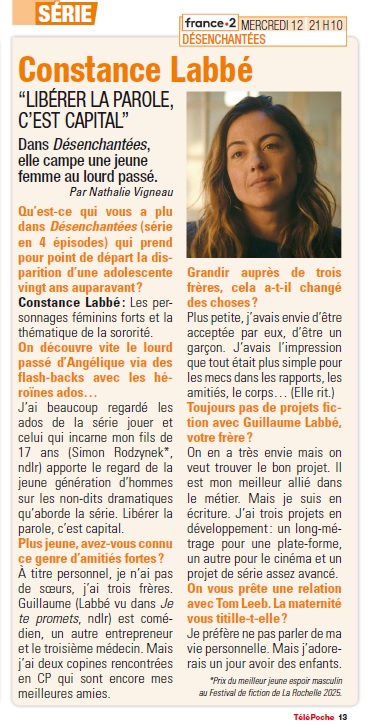
Télépro interview
Veronique


Below is a new interview Constance did with Télépro.

Original French version:

Dans le chaos des “Désenchantées”

Dimanche à 20h50, La Une diffuse deux des quatre épisodes de la minisérie “Désenchantées”, adaptée du roman éponyme de Marie Vareille. À voir également dès mercredi à 21h10 sur France 2.

Fanny, journaliste, est envoyée en province pour couvrir un fait divers vieux de vingt ans : la disparition de Sarah Leroy. Or la jeune femme est persuadée que sa sœur est la responsable de cette affaire…

Au cœur de ce suspense policier se loge une histoire d’amitié qui lie “Les Désenchantées”, une bande d’amies indéfectibles. Parmi elles, Angélique, la sœur de Fanny, campée par l’actrice Constance Labbé. Rencontre.


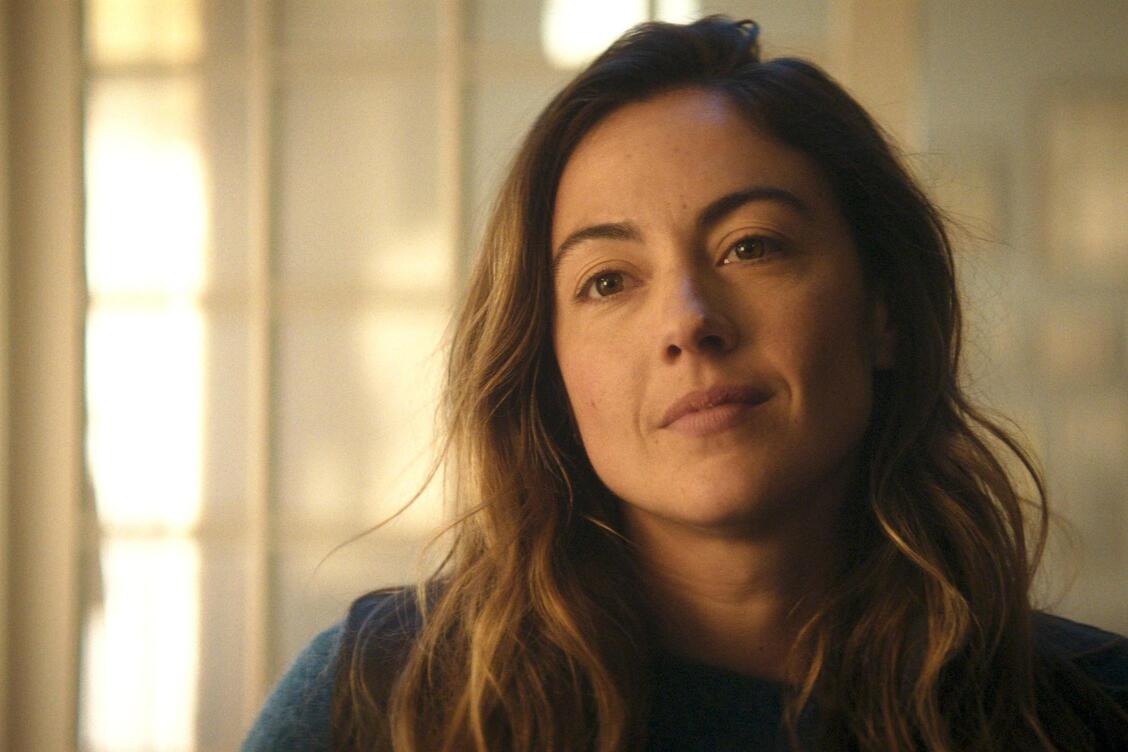
Les deux sœurs : Fanny (Marie Denarnaud) et Angélique (Constance Labbé) © Stephane Grangier

Qu’est-ce qui vous a attirée dans ce personnage ?
Sa complexité et son humanité. Le scénario explore plusieurs thèmes forts : l’amitié, la loyauté, la sororité et la frontière parfois trouble entre séduction et manipulation à l’adolescence. La série filme avec justesse cette fameuse « zone grise », cette ambiguïté dans les comportements adolescents, rarement évoquée dans les fictions.

Partagez-vous certains des traits de caractère d’Angélique ?
Oui, je me reconnais dans son entêtement et dans sa fidélité en amitié. Comme elle, j’ai deux amies d’enfance avec lesquelles j’ai grandi. Pour elles, je serais prête à beaucoup de choses. Dans la série, cette foi absolue en l’amitié, propre à la jeunesse, pousse parfois les personnages à franchir des limites. J’aime cette idée d’élan et d’inconscience qui permet à la fois d’aimer, de protéger et de sauver.

La série aborde aussi le thème du consentement. C‘est un message sociétal ?
Absolument. Contrairement à la période actuelle, dans les années 1990, le refus n’était pas toujours entendu ni respecté. Montrer, à travers une fiction, qu’un « non » doit toujours être écouté permet la réflexion et encourage à changer les comportements.

Les femmes dans les fictions apparaissent souvent comme des rivales. Ici, elles sont solidaires. Était-ce important pour vous ?
Oui, car voir des femmes unies plutôt qu’en compétition est le reflet magnifique d’un changement sociétal majeur. Dans ma vie personnelle aussi, je sens cette solidarité féminine, cette bienveillance entre amies. La série en parle avec justesse, et c’est essentiel de montrer qu’en s’entraidant, on peut surmonter les épreuves et les blessures.

Comment s’est construite votre complicité avec Marie Denarnaud, qui interprète Fanny, votre sœur à l’écran ?
Marie et moi nous étions déjà croisées, mais sans jamais travailler ensemble. Dès nos premières scènes, une véritable magie a opéré : nous avions l’impression de nous connaître depuis toujours. C’était une évidence. D’ailleurs, lorsque le réalisateur David Hourrègue et moi réfléchissions à la comédienne idéale pour ce rôle, nous avons tous deux pensé spontanément à Marie.

Quel message, extrait de la série, aimeriez-vous que le public retienne de cette histoire ?
“Je te crois”. Trois mots simples, mais porteurs d’une confiance absolue.

Source: https://www.telepro.be/actu/tv/dans-le-chaos-des-desenchantees/

Translated to English:

In the Chaos of “Désenchantées”

On Sunday at 8:50 p.m., La Une will broadcast two of the four episodes of the miniseries “Désenchantées”, adapted from the novel of the same name by Marie Vareille. It will also be available to watch starting Wednesday at 9:10 p.m. on France 2.

Fanny, a journalist, is sent to the provinces to cover a twenty-year-old news story: the disappearance of Sarah Leroy. However, the young woman is convinced that her sister is responsible for this case…

At the heart of this police thriller lies a story of friendship that binds “Les Désenchantées”, a group of unwavering friends. Among them is Angélique, Fanny’s sister, played by actress Constance Labbé. An interview follows.


The two sisters: Fanny (Marie Denarnaud) and Angélique (Constance Labbé) © Stephane Grangier

What attracted you to this character?
Its complexity and humanity. The script explores several powerful themes: friendship, loyalty, sisterhood, and the sometimes blurry line between seduction and manipulation during adolescence. The series accurately portrays this so-called “gray area,” this ambiguity in adolescent behavior, which is rarely depicted in fiction.

Do you share some of Angélique’s character traits?

Yes, I recognize myself in her stubbornness and her loyalty in friendship. Like her, I have two childhood friends with whom I grew up. I would be willing to do a lot for them. In the series, this absolute faith in friendship, typical of youth, sometimes pushes the characters to cross boundaries. I like this idea of ​​impulsiveness and recklessness that allows them to love, protect, and save.

The series also addresses the theme of consent. Is that a societal message?

Absolutely. Unlike the present day, in the 1990s, a refusal was not always heard or respected. Showing, through fiction, that a “no” must always be listened to encourages reflection and promotes a change in behavior.

Women in fiction often appear as rivals. Here, they are supportive of each other. Was that important to you?

Yes, because seeing women united rather than in competition is a wonderful reflection of a major societal change. In my personal life too, I feel this female solidarity, this kindness among friends. The series portrays this accurately, and it’s essential to show that by helping each other, we can overcome challenges and hurts.

How did your close working relationship with Marie Denarnaud, who plays Fanny, your sister on screen, develop?

Marie and I had already met, but we had never worked together. From our very first scenes, a real magic happened: we felt like we had known each other forever. It was just meant to be. In fact, when director David Hourrègue and I were thinking about the ideal actress for this role, we both spontaneously thought of Marie.

What message, taken from the series, would you like the audience to take away from this story?

“I believe you.” Three simple words, but carrying absolute trust.

  Articles & Interviews - Désenchantées - Gallery - Photoshoots


RTBF.be article
Veronique


Original article in French:

“Désenchantées” : derrière le polar, une ode à la sororité

Ce n’est pas un polar, c’est une autopsie de l’amitié. Dans “Désenchantées”, la disparition d’une adolescente révèle surtout les blessures d’une génération de femmes qui apprennent, 20 ans plus tard, à se réconcilier avec leurs silences. Une mini-série en quatre épisodes, adaptée du roman de Marie Vareille, à découvrir sur La Une et Auvio dès ce dimanche 9 novembre.

À Bouville-sur-Mer, les fantômes portent des maillots de bain et des bracelets d’amitié. Vingt ans après la disparition de Sarah Leroy, la journaliste Fanny Courtin est envoyée par son journal pour sonder l’ambiance de cette petite bourgade, à l’aube de la libération de son assassin. Elle connaît très bien la région : c’est là qu’elle a grandi avec sa sœur Angélique, meilleure amie de la disparue.

Très vite (et fort heureusement), Désenchantées s’éloigne de ce point de départ convenu (la journaliste qui revient dans son patelin d’origine pour enquêter, on l’a vu et revu), pour se concentrer sur une matière bien plus riche : une adolescence figée entre culpabilité et non-dits, un histoire de violences mises sous le tapis, mais surtout de sororité indestructible.

Derrière le vernis du polar, cette mini-série coproduite par France Télévisions et la RTBF signe surtout un portrait vibrant de femmes à travers le temps et une ode à la résilience féminine.

Mettre en scène le souvenir

Racontée sur deux époques, les années 90 et aujourd’hui, l’histoire de Désenchantées ne s’embourbe pas dans des flashbacks pompeux et scolaires (pas de sépia grossier ni de dates).

La mini-série mêle avec une grande fluidité le présent au passé, en s’appuyant sur une conviction personnelle de son réalisateur, David Hourrègue (Germinal, Anaon) : “Depuis que je suis petit, j’ai toujours eu l’impression qu’on pouvait être très impacté par quelque chose qui ne s’était pas encore produit. J’ai appliqué cette croyance toute personnelle lors du tournage et du montage de la série”. Cette approche osée donne à la série une texture presque organique, où le temps ne se déroule pas, il se superpose. La réalisation est fluide et Désenchantées ne souffre d’aucun temps mort.

Une sororité à l’écran et en coulisses

Si Désenchantées part de la disparition d’une adolescente, elle n’est pas un simple whodunnit et ne s’attelle donc pas uniquement à nous raconter qui est responsable de la disparition de Sarah Leroy. L’histoire est ailleurs. Désenchantées est avant tout une histoire de pacte, d’amitié et de sororité. Fanny a quitté Bouville et ses fantômes pour devenir une femme accomplie. Mais en laissant son passé, et sa sœur Angélique, derrière elle, elle a perdu une partie d’elle-même. Contrainte de revenir pour le travail, elle va déterrer de nombreux secrets, mais aussi renouer avec sa sœur.

Amies dans la vie, les actrices Marie Denarnaud et Constance Labbé étaient ravies de collaborer (enfin) ensemble, comme elles l’ont raconté au Festival de la Fiction de La Rochelle : “On avait une amitié, un désir l’une de l’autre, je dirais. On ne se connaissait pas très bien, mais on avait été présentées et on avait échangé des moments plutôt chouettes”, explique Marie Denarnaud (HPI, Comme une ombre).

“C’est comme en amour, il y a des énergies, renchérit Constance Labbé (Balthazar, Cat’s Eyes). Quand j’ai rencontré Marie, bien avant de tourner “Désenchantées”, j’ai vu quelque chose de familier chez elle. Donc quand David m’a parlé du rôle et m’a demandé avec qui je me sentais bien pour jouer, c’était formidable car j’ai parlé de Marie, et c’était aussi la personne à laquelle il avait pensé”.

Ce réel lien entre les comédiennes se ressent à l’écran. Il donne à Désenchantées une intensité émotionnelle rare, loin des amitiés factices qu’on plaque rapidement sur les récits d’enfance.

Les “Désenchantées”, c’est aussi ce groupe d’amies soudées dans les années 90. Celles qui, contre vents et marées, vont former un pacte et protéger l’une d’entre elles contre la violence. Une amitié indestructible, incarnée notamment par Capucine Malarre (Anaon) et Nelligan (Nudes), toutes deux bouleversantes dans ces rôles d’adolescentes meurtries.

Les filles d’hier, les femmes d’aujourd’hui

Dans Désenchantées, les fantômes ne cherchent pas la vengeance, mais la paix. Ce que la série raconte ce n’est finalement pas la disparition d’une adolescente, mais la lente reconstruction de celles qui restent. Fanny, Angélique et les autres ont sur la peau des cicatrices invisibles, héritées d’un âge où l’on croyait encore que l’amitié suffisait à tout réparer.

En filmant leurs retrouvailles, David Hourrègue signe une œuvre profondément féminine, non pas parce qu’elle exclut les hommes, mais parce qu’elle écoute les femmes. Désenchantées parle de transmission, de mémoire et de pardon. Et c’est sans doute pour ça qu’on en sort ému : parce qu’on reconnaît dans ces héroïnes cabossées, quelque chose de nos propres adolescences.

Désenchantées, une série en quatre épisodes basée sur le roman éponyme de Marie Vareille. Avec Marie Denarnaud, Constance Labbé, Capucine Malarre, Nelligan, Jonas Bloquet, Marc Ruchmann, Daphné Girard, Simon Rodzyneck.

La série a reçu le Prix du Jeune Espoir Masculin pour Simon Rodzyneck au Festival de la Fiction de La Rochelle.

Source: rtbf.be

Translated article in English:

“Désenchantées”: Behind the crime story, an ode to sisterhood

This isn’t a crime drama, it’s an autopsy of friendship. In “Disenchanted,” the disappearance of a teenager primarily reveals the wounds of a generation of women who, 20 years later, are learning to come to terms with their silences. A four-episode mini-series, adapted from the novel by Marie Vareille, to be discovered on La Une and Auvio starting this Sunday, November 9th.

In Bouville-sur-Mer, the ghosts wear swimsuits and friendship bracelets. Twenty years after the disappearance of Sarah Leroy, journalist Fanny Courtin is sent by her newspaper to investigate the atmosphere of this small town, on the eve of the release of her killer. She knows the area very well: it’s where she grew up with her sister Angélique, the missing girl’s best friend.

Very quickly (and fortunately), Désenchantées moves away from this conventional starting point (the journalist who returns to her hometown to investigate, we’ve seen it before), to focus on a much richer subject: an adolescence frozen between guilt and unspoken secrets, a story of violence swept under the rug, but above all, of indestructible sisterhood.

Behind the veneer of a crime story, this mini-series co-produced by France Télévisions and RTBF primarily delivers a vibrant portrait of women across time and an ode to female resilience.

Staging the memory

Told across two time periods, the 90s and today, the story of Désenchantées doesn’t get stuck in pompous and clichéd flashbacks (no crude sepia tones or dates).

The miniseries seamlessly blends the present and the past, drawing on a personal conviction of its director, David Hourrègue (Germinal, Anaon): “Since I was little, I’ve always had the feeling that we could be deeply impacted by something that hadn’t even happened yet. I applied this very personal belief during the filming and editing of the series.” This bold approach gives the series an almost organic texture, where time doesn’t unfold linearly, but rather overlaps. The direction is fluid, and Désenchantées suffers from no dull moments.

A Sisterhood on Screen and Behind the Scenes

While Désenchantées begins with the disappearance of a teenager, it’s not simply a whodunit and therefore doesn’t solely focus on telling us who is responsible for Sarah Leroy’s disappearance. The story lies elsewhere. Désenchantées is above all a story of a pact, friendship, and sisterhood. Fanny left Bouville and its ghosts to become an accomplished woman. But by leaving her past, and her sister Angélique, behind, she lost a part of herself. Forced to return for work, she will unearth many secrets, but also reconnect with her sister.

Friends in real life, actresses Marie Denarnaud and Constance Labbé were delighted to (finally) collaborate together, as they explained at the La Rochelle Fiction Festival: “We had a friendship, a desire to work with each other, I would say. We didn’t know each other very well, but we had been introduced and had shared some pretty great moments,” explains Marie Denarnaud (HPI, Comme une ombre).

“It’s like in love, there are certain energies,” adds Constance Labbé (Balthazar, Cat’s Eyes). “When I met Marie, long before filming ‘Désenchantées,’ I saw something familiar in her. So when David talked to me about the role and asked me who I felt comfortable acting with, it was fantastic because I mentioned Marie, and she was also the person he had in mind.”

This genuine connection between the actresses is palpable on screen. It gives Désenchantées a rare emotional intensity, far removed from the artificial friendships often superficially depicted in coming-of-age stories.

“Désenchantées” is also about this close-knit group of friends in the 90s. These girls, against all odds, form a pact and protect one of their own from violence. An indestructible friendship, embodied notably by Capucine Malarre (Anaon) and Nelligan (Nudes), both captivating in their roles as wounded teenagers.

The girls of yesterday, the women of today

In Désenchantées, the ghosts don’t seek revenge, but peace. What the series ultimately tells is not the disappearance of a teenager, but the slow reconstruction of those who remain. Fanny, Angélique, and the others bear invisible scars, inherited from an age when they still believed that friendship was enough to heal everything.

By filming their reunion, David Hourrègue has created a profoundly feminine work, not because it excludes men, but because it listens to women. Désenchantées is about transmission, memory, and forgiveness. And that’s undoubtedly why it’s so moving: because we recognize in these flawed heroines something of our own adolescence.

Désenchantées, a four-episode series based on the novel of the same name by Marie Vareille. Starring Marie Denarnaud, Constance Labbé, Capucine Malarre, Nelligan, Jonas Bloquet, Marc Ruchmann, Daphné Girard, and Simon Rodzyneck.

The series received the Young Male Talent Award for Simon Rodzyneck at the La Rochelle Fiction Festival.
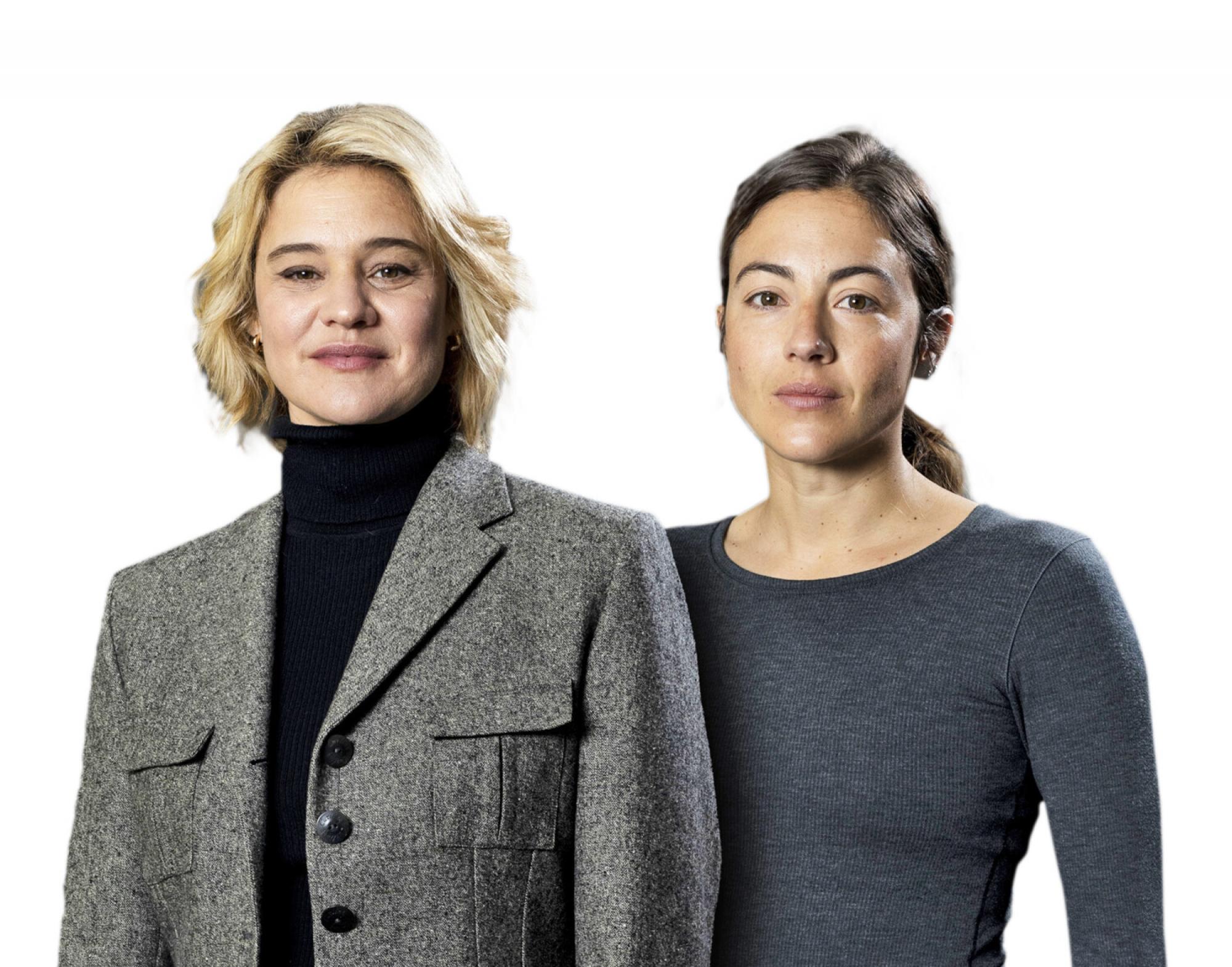
  Articles & Interviews - Désenchantées


Site Info
  • Maintained by: Veronique
  • Since: 5 June 2025
  • Layout Photos: Victor Jeffreys, Patrice Normand, Lisa Lesourd, Roxana Oana & Marie Rouge
  • Hosted by: Asura Hosting
  • Contact: Email Veronique
Current Projects
Cat's Eyes (Season 2)
2025
Three sisters run a café by day, and moonlight as notorious art thieves.

Désenchantées
2025
The disappearance of fifteen-year-old Sarah Leroy shocked the small town of Bouville-sur-Mer and moved the whole of France. A culprit was quickly arrested. Yet, in every home, every bar, theories continued to be developed. What really happened, no one ever knew. Twenty years later, Fanny, a journalist, returns to the scene of this tragedy that marked her youth. And an entire past resurfaces... Because Sarah Leroy's story is also a bit her own, that of her sister Angélique, and that of a group of girls, "The Disenchanted," who knew Sarah only too well. A story that reeks of chlorine from the municipal swimming pool, of vows of friendship, and, above all, of the darkest secrets.

Adieu Jean-Pat
2025
A young man is compelled to arrange the funeral of his childhood foe.