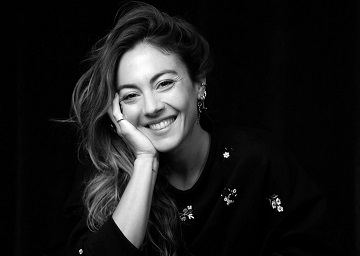
Constance Labbé: “Adults tend to downplay what teenagers are feeling”
Constance Labbé stars in the highly successful series “Désenchantées”, currently airing on France 2. We met her at the La Rochelle Fiction Festival, where the series was in competition.
Paris Match: How did you get involved in the series?
Constance Labbé: I was incredibly lucky to receive an offer from director David Hourrègue, with whom I had never worked before. I knew him because he had recently worked with my brother, Guillaume Labbé, on the series “Anaon”. He was familiar with my work, and I was familiar with his. He wrote me an absolutely beautiful letter, telling me he would love to collaborate with me on this role. It was incredibly touching. I’m always surprised when people tell me, “I love your work”, or “I want to work with you”. I hope to be surprised all my life, actually.
Have you read the novel “Désenchantées” by Marie Vareille, which inspired the series?
I wasn’t familiar with the book; I read it afterward and I loved it. I read the adaptation, which was still a work in progress. I really enjoyed that too. I was worried about certain things, which David executed wonderfully. I was very scared; it’s hard to direct teenagers. In fact, I think that’s almost the best part. This dual timeline (between adults and their teenage selves, Ed.)—the way the director explained to me how he wanted to approach it—really appealed to me. He told me I had to trust him, that he wasn’t necessarily looking for people who were similar to him, that he had faith in the power of fiction, the power of editing.
What did you bring of yourself to this character?
I was able to suggest certain things, even during the writing process, about the character, about her journey, which was great. It was really wonderful to be listened to like that. I really worked on it with David, right from the writing stage. In the book, my character, Angélique, is a bit more absent; she’s more central to the series.
What remains with you from this series? Are there things that still resonate today?
Often with my roles, it’s feelings that stay with me, more than character traits or images. Now, talking about it in interviews, things come back, feelings, incredibly strong emotions. Angélique is someone very strong, who has taken a huge blow, who has built up an enormous shell around herself, but who is always walking a tightrope. I also wanted people to feel that it’s not far off. In her gaze, in her eyes, there’s this cracking feeling. He mustn’t be too far away. And I feel that’s where it is.
Did it make you relive your adolescence, for example?
No, not really. I didn’t have the same adolescence at all. Besides, I don’t have a sister, I only have brothers. I was lucky enough to have done the series “Cat’s Eyes” not long ago, where I have two sisters. So, I had already really worked on that relationship.
Do you have any memories of adolescence that came back to you?
That intensity of what you feel when you’re a teenager… Everything is absolute. All the sensations, all the feelings are pushed to the extreme. I remember the letters we wrote to each other when we argued… How dramatic it was. Life stops… And love stories! When the guy you’re in love with doesn’t want to see you. I remember being in love, for example, with the same boy as my friend. But it was so dramatic if she went out with him and I didn’t, or vice versa. I think we adults tend to really downplay what teenagers feel. We’ve forgotten the intensity of those feelings.
How far would you be willing to go for friendship?
Friendship is love. It comes from exactly the same place. Honestly, for the few people who are truly closest to me, I’d be willing to do anything, even swim across the ocean.
There’s a throwback to the 1990s in the series, which is your generation… The Walkman, the Nintendo, the absence of cell phones and social media… We didn’t use WhatsApp to visit each other’s houses… It’s really a Proustian madeleine. There’s definitely a hugely positive side and a hugely negative one. On the one hand, I thought, “Damn, it was so much better without cell phones.” I created games. We went out, we invented all sorts of things because we weren’t on our phones. We made real dates. And at the same time, it was a time when women weren’t really defended, teenagers weren’t listened to, weren’t believed, and freedom of speech wasn’t at all encouraged. There are good things to keep, and there are bad things.
Original French article at parismatch.com